


Expert Guide: “Understanding Pain”
This section presents the fundamental mechanisms of pain: why it appears, how a signal coming from the tissues becomes a pain experience, why it can persist even though no lesion is visible, and why it is not always felt where its origin lies.
Each entry links to an article that can be read on its own, exploring nociceptionNociceptionNociception is the process by which the nervous system detects and encodes stimuli that are potentially damaging to tissues. It is not the same as pain, which is an experience.Read the full entry : Nociception, tissue adaptive capacity, the mechanisms of hypersensitization and neurosensory deprogrammingNeurosensory deprogrammingNeurosensory deprogramming refers, in the functional model developed by Blue Portance from the work of Pierre Ivaldi, to the progressive loss of the nervous system’s ability to calibrate its response correctly based on the sensory information it actually receives.Read the full entry : Neurosensory deprogramming, the interplay between physical pain and psychological suffering, as well as the levers for getting out of chronic painChronic painPain is called chronic when it persists or recurs for more than three months. It may accompany an identified disease or be a condition in its own right.Read the full entry : Chronic pain.
This guide is structured as a recommended 5-part path: the starting point (why pain appears), the three main recognized mechanisms (nociceptive, neuropathic, nociplastic), their possible progression to chronic pain (hypersensitization, neurosensory deprogramming), the interplay between physical pain and psychological suffering (adaptive loops), and finally a synthesis focused on care and the levers for getting out of it.
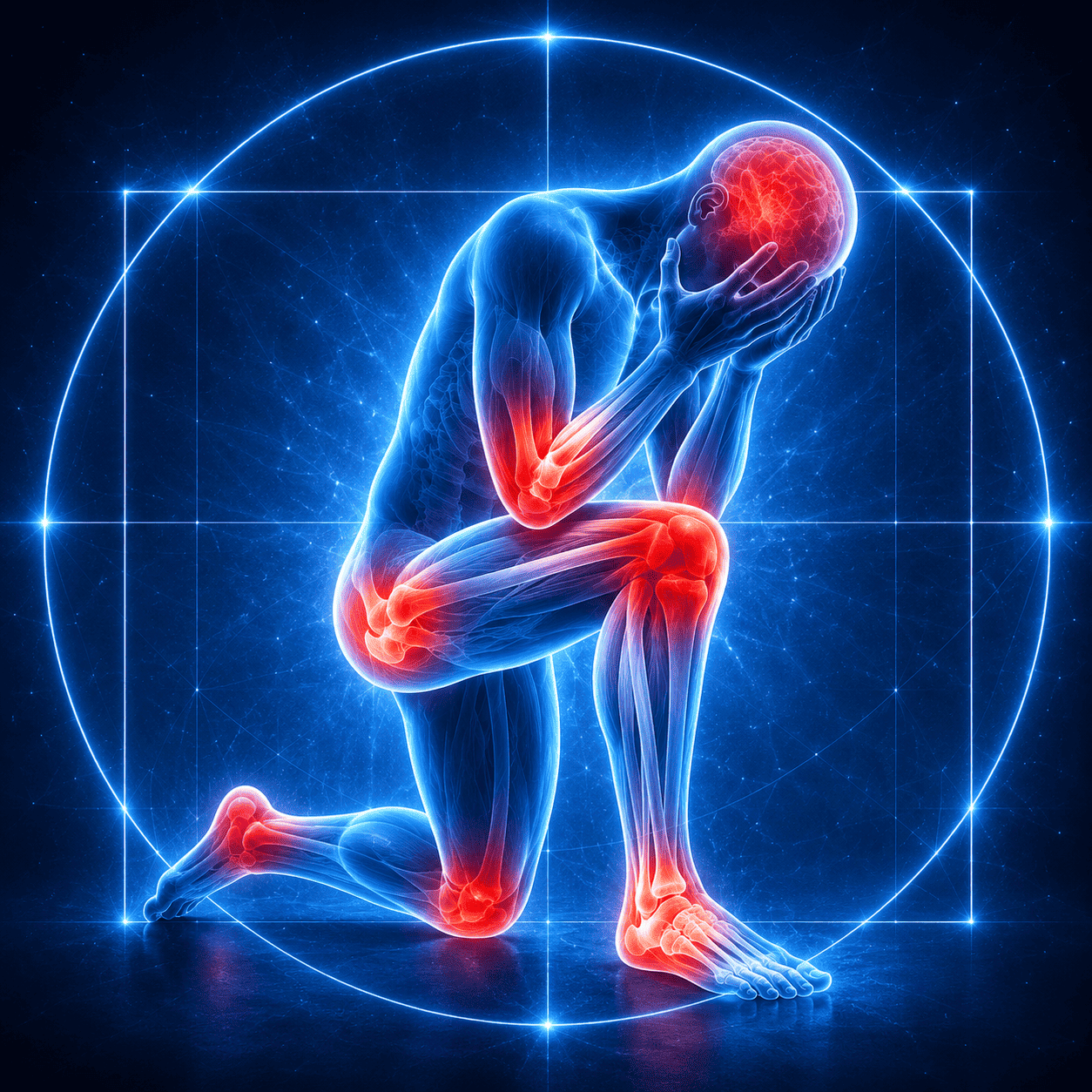
1. The Starting Point
How stress becomes pain: the founding question of this entire guide.
Why Do I Hurt? Understanding the Mechanism of Pain
Understanding how stress applied to a tissue can activate nociceptors, be transmitted to the nervous system, and then become a pain experience.
Read the article →2. The Mechanisms of Pain
Three main mechanisms recognized by the international classification (IASP), and the areas where they overlap.
Nociceptive, Neuropathic, and Nociplastic Pain: Three Mechanisms That Can Combine
Three mechanisms that can combine: the international (IASP) classification of pain mechanisms, before exploring each of them in detail.
Read the article →Nociceptive Pain: When Stress Exceeds a Tissue’s Adaptive Capacity
When stress exceeds a tissue’s adaptive capacity: the most common mechanism of sitting-related pain.
Read the article →When Does a Compressed Nerve or a Nerve Under Tension Become Painful?
The transition stage between nociception and neuropathy.
Read the article →Neuropathic Pain
When the somatosensory nervous system itself is damaged or disrupted.
Read the article →Nociplastic Pain
When the way the nervous system processes pain-related information changes, without tissue damage or nerve involvement sufficient to explain it.
Read the article →3. Hypersensitivity and Neurosensory Deprogramming
How the nervous system can change its alarm thresholds over the long term, and why this is not limited to an isolated dysfunction.
Three closely related notions should be distinguished from the outset: nociplastic painNociplastic painNociplastic pain is pain arising from altered nociception, without clear evidence of tissue damage activating nociceptors, or of a lesion or disease of the somatosensory system sufficient to explain the pain.Read the full entry : Nociplastic pain refers to a mechanism recognized by the international classification (IASP), hypersensitization describes a cross-cutting process that may accompany it, and neurosensory deprogramming is an interpretive model specific to Blue Portance: a complementary reading, not a recognized medical classification.
Nervous System Hypersensitization
Why pain can persist when everything seems normal: central sensitization, the role of fascia and of mechanical variability.
Read the article →Neurosensory Deprogramming: Why Does Pain Continue When Nothing Seems to Explain It Anymore?
What is referred to as neurosensory deprogramming: documented mechanisms (hyperexcitability, engrams, brain reorganization), limitations, and controversies.
Read the article →4. Psychological Pain and Adaptive Loops
When psychological suffering and physical pain follow on from each other and sustain each other.
Psychological Pain: An Invisible but Real Suffering
From the phrenalgia described by Joseph Guislain to current neuroscience insights into social suffering: understanding psychological pain as a mechanism, not as a judgment.
Read the article →Adaptive Loops: Physical Pain and Psychological Suffering
How physical pain, psychological suffering, sleep, stress, behaviors, and sensitization can follow on from each other and sustain each other.
Read the article →5. Getting Out
The main families of therapeutic approaches, the role of the predictive brain, and the synthesis of the guide.
Getting Out of Chronic Pain: Restoring the Adaptive Capacities of the Living Organism
Why there is no universal treatment for chronic pain, and how several approaches can work together to interrupt the adaptive loops that sustain it.
Read the article →When the Brain Can Take Back Control: Understanding the Placebo and Nocebo Effects
The placebo effect is not imaginary: it corresponds to measurable changes in the way the nervous system modulates pain. The predictive role of the brain, the nocebo effect, and what this changes for care.
Read the article →A Three-Level Reading
These pages distinguish three levels that it is essential not to confuse:
- Tissue and stress: a mechanical demand acts on a structure that has its own adaptive capacity.
- Nociception: when this capacity is exceeded, specialized receptors can transmit an alarm signal.
- Pain: the nervous system integrates this signal with the biological, mechanical, emotional, and cognitive context, then produces a pain experience.
This distinction helps explain why pain can be real without a visible lesion, persist after the initial tissue has recovered, or be felt at a distance from the structure that triggered the signal.
© Gil Ayache. The concepts, diagrams, terminology, and principles presented on this page constitute a work protected by copyright. They are made available to Blue Portance under an intellectual property license agreement, without transfer of economic rights or of authorship.


