
MY QUICK GUIDE TO CHOOSING MY SEAT (choice of version)
1. Choose the Aporia® version that best suits my discomfort
All Aporia® seats are designed to ease strain on the back, muscles and fasciaFasciaFascia are connective tissue structures that envelop, connect or separate certain parts of the body. The "fascial system" refers to a broader set of connective tissues considered in their functional continuity.Read the full entry : Fascia when sitting while preserving the body’s natural mobility.
Alongside the version without a cut-out (Standard), we offer three additional versions with cut-outs, which may also be considered for pelvic and perineal discomfort.
To find the right version, I pick out in the lists below the situations in which I feel discomfort or pain when sitting.
My situations of discomfort and pain
Scroll to see more options…
- I sit for long periods, for example at work
- When sitting, I have musculoskeletal discomfort: joints, muscles, tendons
- At the end of the day, my back, shoulders, wrists or elbows hurt
- I have recurring or persistent back pain (low back painLow back painLow back pain is pain in the lower back, located between the thoracolumbar junction and the gluteal fold. In the vast majority of cases it is described as common (non-specific): it is mechanical in origin and does not stem from a serious disease.Read the full entry : Low back pain, disc problems, herniated discHerniated discA herniated disc is the localized displacement of part of the intervertebral disc, most often the nucleus, through a tear in the annulus fibrosus. It can irritate or compress a nerve root, but it is also frequently painless.Read the full entry : Herniated disc)
- I have myofascial pain or fibromyalgiaFibromyalgiaFibromyalgia is a chronic pain syndrome combining persistent widespread pain, fatigue, sleep disturbances and often difficulty concentrating, with no tissue damage that could on its own explain the intensity of the symptoms.Read the full entry : Fibromyalgia
- I feel uncomfortable when sitting and often change position
- I am looking for lasting comfort when sitting, with no particular constraint
- I want to improve my everyday posture
- I want to prevent discomfort from prolonged sitting
- I want to maintain my muscle tone while sitting
Standard version
No cut-out – for diffuse back discomfort and prolonged sitting

My situations of discomfort and pain
Scroll to see more options…
- I feel discomfort or pain in the perineal area (vaginal, scrotal or urogenital)
- I have pudendal neuralgiaPudendal neuralgiaNeuropathic pain in the territory of the pudendal nerve (perineum, external genitalia, anal region), often made worse by sitting.Read the full entry : Pudendal neuralgia or combined cluneal neuralgiaCluneal neuralgiaCluneal neuralgia is pain linked to irritation of the cluneal nerves, small sensory nerves of the skin of the buttock. Depending on the branch involved, it is felt in the upper buttock and lower back, or in the lower buttock, sometimes markedly when sitting.Read the full entry : Cluneal neuralgia
- I have endometriosisEndometriosisEndometriosis is a chronic inflammatory disease in which tissue similar to the lining of the uterus grows outside the uterine cavity. It can cause severe pelvic pain and infertility.Read the full entry : Endometriosis with pain that increases when sitting
- I feel burning, numbness or pressure in the center of the seat
- I have recently given birth or had gynecological, urological or pelvic surgery
- I need to avoid prolonged pressure on the perineal area
- I need lasting comfort when sitting despite hypersensitivity in this area
- I want to improve my daily life by reducing the impact of perineal discomfort when sitting
- I want to prevent it from getting worse when I sit for long periods
- I am looking for a seat that relieves the perineal area while supporting my posture
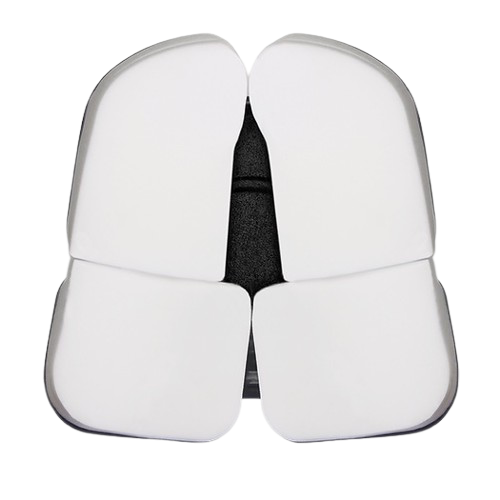
Périnée version
Central cut-out – for perineal discomfort, with or without back discomfort
My situations of discomfort and pain
Scroll to see more options…
- I have localized pain in my tailbone
- I have coccydyniaCoccydyniaPain located in the tailbone (coccyx) region, often worse when sitting.Read the full entry : Coccydynia
- I feel pain or discomfort in the anal area or in the cleft between the buttocks (e.g. hemorrhoids, certain forms of pudendal neuralgia, sacral pressure sore, pilonidal cyst)
- I am recovering from surgery on the sacrum or anal area
- I need to avoid any direct contact with the sacral area when sitting
- I am looking for tailbone relief during prolonged sitting
- I want to improve my everyday comfort despite tailbone pain
- I want to prevent tailbone pain, or injury to this sensitive area, from getting worse when I sit for long periods
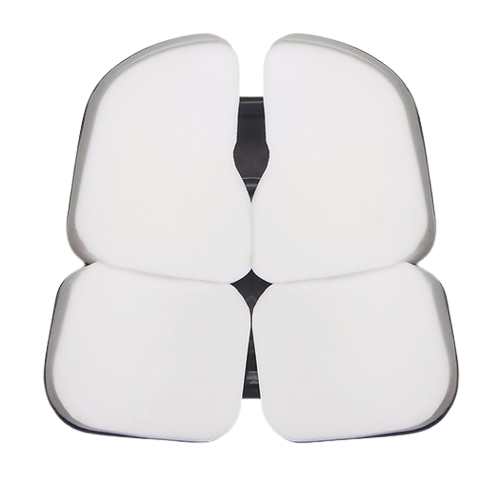
Coccyx version
Rear cut-out – to relieve the sacral or anal area
My situations of discomfort and pain
Scroll to see more options…
- I feel discomfort or pain in the pelvic floorPelvic floorThe pelvic floor is a deep group of muscles and connective tissues located in the lower part of the pelvis. It contributes to the support of the pelvic organs, to sphincter function and to the mechanical coordination of the abdominopelvic complex.Read the full entry : Pelvic floor area when sitting
- I need to avoid any direct pressure on the perineal area completely
- I have pudendal neuralgia with rectal or anal pain when sitting
- I have rectal pain with pressure, burning or deep pelvic discomfort
- I have combined perineal and tailbone discomfort
- I feel burning, stabbing or deep pain in the pelvic area when sitting
- I am recovering from pelvic, perineal or colorectal surgery
- I need as much pressure relief as possible in the center of the seat
- I cannot tolerate contact with conventional cushions or seats
- I am looking for the gentlest possible seat
Canyon version
Continuous center channel – when several areas along the midline need relief at the same time