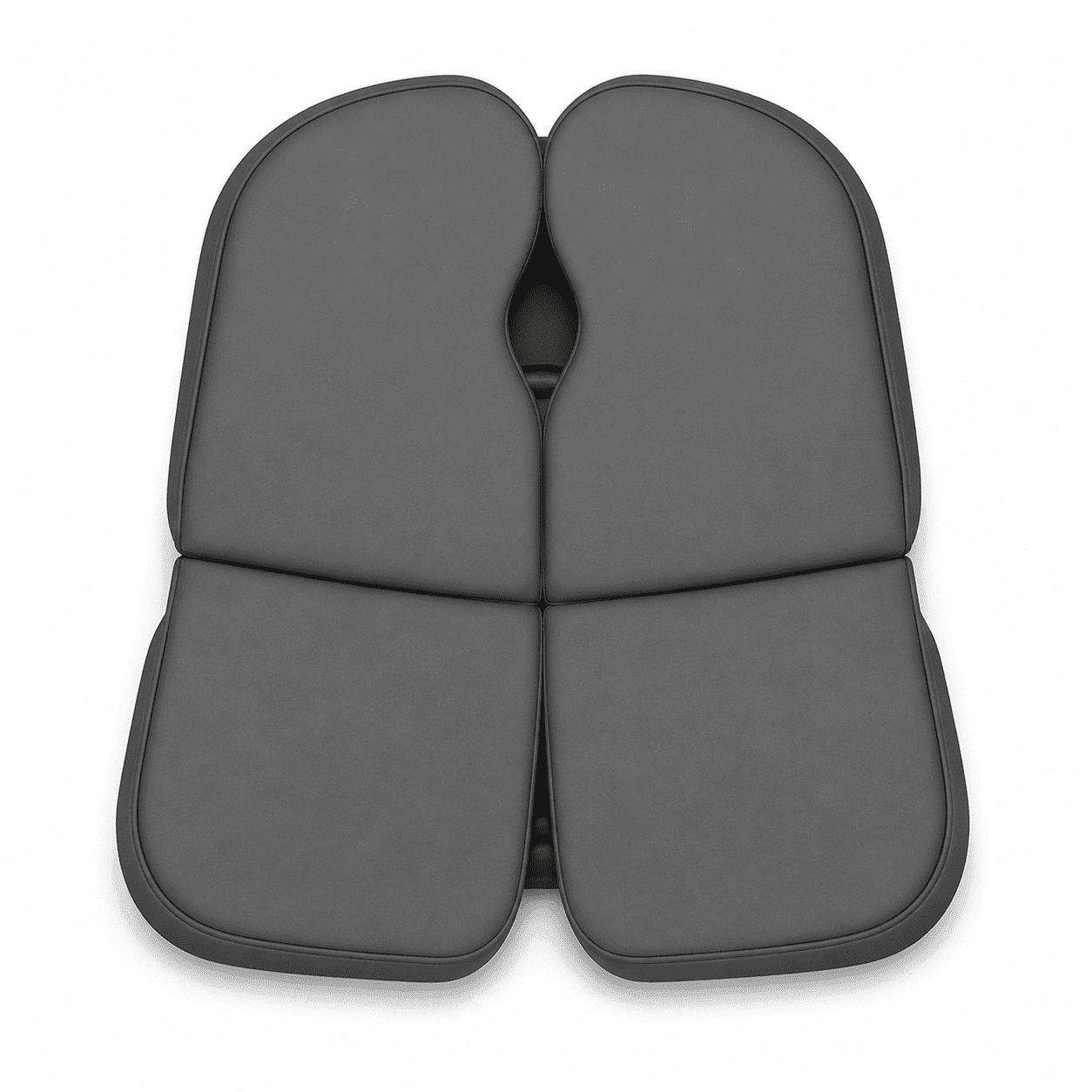
Who is it for? Looking for a cushion for back pain when sitting, low back pain, buttock or sit bone pain, cluneal neuralgia, or sitting difficulties associated with fibromyalgia? The Aporia Standard favors continuous, dynamic support, when it is tolerated and no localized cut-out is needed.
In the Aporia approach, clearly painful sit bones lead to choosing continuous support, so as not to create more empty space around the painful sit bone; individual tolerance still needs to be checked during the trial.
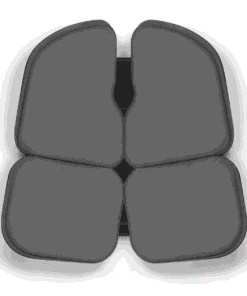
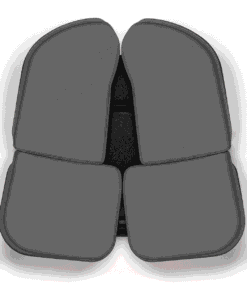
How is it different from a foam or gel cushion? A foam or gel cushion is a single block: it sinks under your weight and responds as one piece, on both sides at once. The Aporia Standard keeps continuous support under the sit bones and thighs, but on four independent supports mounted on ball joints and set on a curved base: each side responds separately and the whole seat keeps its balance during adjustments.
“[…] I finally enjoy sitting again and I can get back to a normal social life.” — Sandrine (translated from French) Read the reviews
Join Sandrine and the 85% of our customers who keep their cushion at the end of the 30-day trial.
Which version should you choose? A diagnosis is not enough: it all depends on which contact areas are painful, which ones are still tolerated, and how you respond to movement. Selection guide
Aporia acts on the mechanical conditions of sitting; it does not treat the condition itself.
Which firmness should you choose?
The choice of firmness does not depend only on how intense the pain is: above all, it depends on how your body responds to pressure, to sinking in, and to the support of the seat.
(Click each firmness option to see the details.)
Balanced Comfort — dynamic support
This is the reference configuration and the most widely chosen. It favors load-bearing support, stable contact points and a responsive cushion, while leaving the pelvis free to make its micro-movements.
Choose it if you are looking for:
- • firmer support and stable contact points;
- • a seat that limits the feeling of sinking in;
- • a dynamic response that accompanies the adjustments of the pelvis;
- • enough load-bearing support without a pronounced enveloping feel.
It may also be preferable when overly soft seats cause a feeling of sinking, pulling or stretching, or make the pain worse over time.
Feel: a comfortable first contact with firmer, stable and responsive support.
Enveloping Comfort — a more gradual feel
This configuration adds 2 cm of viscoelastic (memory) foam to make loading more gradual and soften pressure peaks at the points of contact.
Choose it if you mainly have:
- • strong sensitivity to contact pressure;
- • contact points that feel too harsh as soon as you sit down;
- • sensitive superficial tissues that need a more gradual first contact;
- • usually better tolerance of soft seats than of firm ones.
Feel: a softer, enveloping first contact, with more gradual loading.
⚠️ Softer does not always mean better suited. If soft seats give you a feeling of sinking in, lack of support, or pulling or stretching of the tissues, Balanced Comfort may be preferable.
Not sure? Your own experience is a good guide: notice in particular whether you usually feel better on a firm, supportive seat or on a softer, enveloping one.
Unsure about the version or the firmness? Our selection guide helps you identify which contact areas to keep and which to relieve. You can also call us for personalized advice before ordering: +33 6 15 77 81 36 (Monday–Friday, 9 a.m.–5 p.m., Paris time).