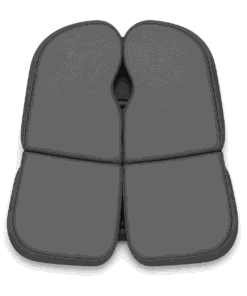
Perineal Relief Cushion APORIA® Canyon – Continuous Center Channel, Balanced Dynamic Seating with Independent Supports
€355,00
Who is it for? Looking for a cushion for combined perineal, anal and tailbone pain, particularly in some cases of pudendal neuralgia or painful endometriosis? The Aporia Canyon removes direct pressure along the midline, from the pubic bone to the tailbone; the load is shifted toward the buttocks, sit bones and thighs, whose tolerance needs to be checked.
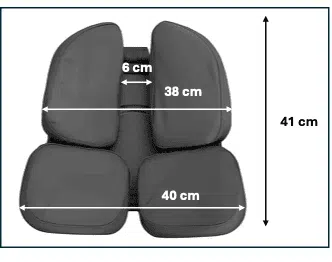
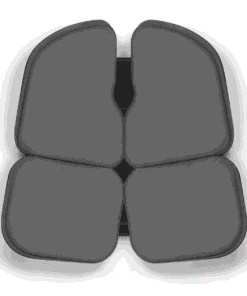
How is it different from a channel cushion? A channel cushion removes a strip of material in the center, with a fixed block of foam on either side. The Aporia Canyon clears the midline from the pubic bone to the tailbone (6 cm channel along its whole length) and carries each half of the pelvis on two independent supports mounted on ball joints, which follow the adjustments of the sitting position.
Aporia technology studied at Nantes University Hospital. The Pelvi-Seat study (2023) evaluated two Aporia seats. The Canyon version was not included in this study. Read the report
Join the 85% of our customers who keep their cushion at the end of the 30-day trial.
In short. Balanced dynamic seating with independent supports: four supports on ball joints accompany the small movements of the pelvis, without locking it in place or throwing it off balance. 6 cm continuous center channel · 41 × 40 × 12 cm · about 1.7 kg · two firmness options · 30-day trial.
Which version should you choose? A diagnosis is not enough: it all depends on which contact areas are painful, which ones are still tolerated, and how you respond to movement. Selection guide
Aporia acts on the mechanical conditions of sitting; it does not treat the condition itself.
Which firmness should you choose?
The choice of firmness does not depend only on how intense the pain is: above all, it depends on how your body responds to pressure, to sinking in, and to the support of the seat.
(Click each firmness option to see the details.)
Balanced Comfort — dynamic support
This is the reference configuration and the most widely chosen. It favors load-bearing support, stable contact points and a responsive cushion, while leaving the pelvis free to make its micro-movements.
Choose it if you are looking for:
- • firmer support and stable contact points;
- • a seat that limits the feeling of sinking in;
- • a dynamic response that accompanies the adjustments of the pelvis;
- • enough load-bearing support without a pronounced enveloping feel.
It may also be preferable when overly soft seats cause a feeling of sinking, pulling or stretching, or make the pain worse over time.
Feel: a comfortable first contact with firmer, stable and responsive support.
Enveloping Comfort — a more gradual feel
This configuration adds 2 cm of viscoelastic (memory) foam to make loading more gradual and soften pressure peaks at the points of contact.
Choose it if you mainly have:
- • strong sensitivity to contact pressure;
- • contact points that feel too harsh as soon as you sit down;
- • sensitive superficial tissues that need a more gradual first contact;
- • usually better tolerance of soft seats than of firm ones.
Feel: a softer, enveloping first contact, with more gradual loading.
⚠️ Softer does not always mean better suited. If soft seats give you a feeling of sinking in, lack of support, or pulling or stretching of the tissues, Balanced Comfort may be preferable.
Not sure? Your own experience is a good guide: notice in particular whether you usually feel better on a firm, supportive seat or on a softer, enveloping one.
Unsure about the version or the firmness? Our selection guide helps you identify which contact areas to keep and which to relieve. You can also call us for personalized advice before ordering: +33 6 15 77 81 36 (Monday–Friday, 9 a.m.–5 p.m., Paris time).

Verified customer reviews: 4.6 stars on Trustpilot.
🛡️ 30-day money-back guarantee
🚚 Free shipping within mainland France
Shipping costs for other countries are calculated at the next step.


Detailed features
The APORIA® Canyon cushion is balanced dynamic seating with independent supports and a continuous center channel, from front to back, which removes support along the entire midline of the pelvis, from the pubic bone to the tailbone. Same ExoBase™ as the other versions: a curved base allowing general 360° rocking; four independent supports mounted on the base (two elongated ones at the back, under the buttocks; two square ones at the front, under the thighs), each on an elastomer ball joint with its own mobility and limited travel.
This version may be considered when pressure along a large part of the midline triggers or increases symptoms and the buttocks and thighs tolerate pressure; if the sit bones are clearly painful, this version should not be favored if the edges of the channel risk concentrating the load on a painful sit bone.
| Feature | Value |
|---|---|
| Cut-out | 6 cm wide continuous center channel, from front to back |
| Dimensions | 41 cm deep × 40 cm wide at the front (38 cm at the back) × 12 cm high; about 1.7 kg |
| Firmness options | Balanced Comfort or Enveloping Comfort; anti-bottoming layer |
| Adjustment | Two wedges included |
| Cover | Removable, machine washable |
Trial and purchase: 30-day trial; free returns from anywhere in the European Union; your choice of an exchange (version and/or firmness; shipping of the new product paid by the customer, new 15-day trial) or a full refund; personalized help getting started. Trial, return and refund conditions
When it may help and points to watch
Situations in which this version may be relevant
- Pain or symptoms extending along the midline, from the pubic bone to the tailbone (genital, perineal, anal and tailbone regions), when pressure on this line triggers or increases them.
- A central cut-out (Périnée) or rear cut-out (Coccyx) that does not cover the whole area that does not tolerate pressure.
- Strong hypersensitivity to seat contact along the midline, provided the buttocks and thighs tolerate pressure.
- Pain that is stronger on one side: each support responds separately, which allows a different load on the left and on the right.
Points to watch
- Clearly painful sit bones: the sit bones are close to the edges of the channel; this version should not be favored if the edge risks concentrating the load on a painful sit bone. In that case, look for a version that keeps more continuous support around the sit bone, without giving up the cut-out you need.
- Shifted load poorly tolerated: the channel shifts the load onto its edges, the buttocks and the thighs; if these areas tolerate pressure poorly, this version is not suitable.
- Pain limited to one area (the center only, or the back only): a more targeted cut-out (Périnée or Coccyx) avoids removing support over a wider area than necessary.
- Small movements that bring back the pain at first: start with short periods and adjust the firmness and the wedges during the trial.
- Several areas, or you are not sure: the selection guide asks every solution the same questions.
These guidelines are not medical contraindications. A diagnosis alone is not enough to choose a version: what matters is the area that does not tolerate pressure and the way sitting affects your symptoms. If in doubt, ask your doctor for advice.
Why a continuous channel?
The choice of a continuous channel answers a mechanical need: avoiding several poorly tolerated contacts at the same time. It is not derived from the path of a nerve. When pressure triggers symptoms in several of these areas at once, a cut-out limited to the center or the back leaves part of the midline in contact with the seat. The continuous channel removes this contact along the whole length; in return, more of the load shifts onto the buttocks and thighs.
What the seat does
- Continuous center channel: it removes seat contact along the whole midline, from front to back; the load is taken up by the side supports, notably the buttock regions, the sit bones and the thighs. How the load is actually distributed, and how well the load-bearing areas tolerate it, needs to be checked during the trial.
- Independent supports: each side responds separately and each half of the pelvis is carried separately; a different load on the left and on the right can be accommodated without sitting crooked.
- Balance of the whole seat: the seat is designed to limit the effort needed to hold yourself up when sitting, one of the possible sources of pelvic muscle tightening.
- Micro-movements: you initiate the movement; the seat accompanies it. It does not move the pelvis on its own.
→ What is balanced dynamic seating with independent supports? · How does the Aporia seat work?
What has been evaluated
- Pelvi-Seat study, Nantes University Hospital, 2023 (user satisfaction study): it covered two APORIA® seats; the Canyon version was not one of them. Its results therefore do not apply directly to this version. Read the report
- Kept after the trial: 85% of cushions are kept at the end of the 30-day trial.
- Patent: design protected by French patent FR 3 140 745 B1; applications published in Europe (EP 4 604 808) and in the United States (US 2026/0144378 A1).
Aporia® is not a medical device: it does not treat any condition and does not replace medical advice.
Frequently asked questions
What is the difference between the Aporia Canyon and the Aporia Périnée? The Périnée version removes support in the center, under the perineum, with a cut-out that widens from 3 to 6 cm. The Canyon version extends the cut-out into a 6 cm channel along the whole length, from front to back. It therefore removes support over a wider area and shifts more of the load onto the buttocks and thighs.
Is the Aporia Canyon suitable if my sit bones hurt? With caution. The sit bones are close to the edges of the channel: the Canyon should not be favored if that edge risks concentrating the load on a painful sit bone. In that case, look for a version that keeps the necessary area out of contact while keeping more continuous support around the sit bone. The selection guide helps you check.
Should I choose the Canyon as soon as I have pain in several places? Not as a rule. The Canyon fits situations where pressure triggers symptoms along a large part of the midline. If the pain is limited to the center or the back, a more targeted cut-out, Périnée or Coccyx, removes less support. If the sit bones are painful, check that the edges of the channel do not concentrate the load on them.
Does the cushion move on its own? No. The seat has no motor and does not move the pelvis on its own. You initiate the movement; the curved base and the four supports on ball joints accompany it, with limited travel, while preserving the balance of the whole seat.
Can I try it before buying? Yes. You have a 30-day trial. Returns are free from anywhere in the European Union, and you choose between an exchange (version and/or firmness) and a full refund. For an exchange, shipping of the new product is at your expense and the product you receive gets a new 15-day trial. 85% of cushions are kept at the end of the 30-day trial.
| fermeté | Balanced Comfort – Dynamic Support (Balanced Dynamic Support), Enveloping Comfort – Memory Foam Feel (Soft Comfort – Memory Foam Feel) |
|---|
Composition
- 1 thermoformed base
- 4 thermoformed supports
- 1 cushion cover (BERENGIER ENDURANCE – 100% polyester)
- 2 wedges
Details
- Removable, machine-washable cover
- Portable seat with carrying handle
Care
To clean your cushion
- First remove the four covers that hold the four pads
- Machine wash at 40 °C maximum (you can of course wash them by hand, but you must respect the temperature limits)
- Iron at low temperature (110 °C maximum)
- Do not bleach
- Tumble drying is strongly discouraged
Shipping and returns
Shipping
- Free in mainland France, delivered to your door.
- Other European countries: flat rate of €20 per order; Switzerland: €30; other countries: costs shown at checkout.
- Delivery time: 8 to 10 business days.
Returns
- 30 days to try the product, satisfaction guaranteed or your money back.
- Free returns from anywhere in the European Union.
- Your choice: full refund or exchange (version or firmness). For an exchange, shipping of the new product is paid by the customer and the product you receive gets a new 15-day trial.
Related products

Bioactive Cushions
Coccyx Cushion APORIA® – Rear Cut-Out, Balanced Dynamic Seating with Independent Supports